Voice Data Collection: The Consent Trail Decides If Your Model Ships

Voice data collection buys you two things. Audio, and proof that you were allowed to record it. Teams negotiate hard on the first and assume the second. Then a security review asks where the voices came from, and the answer either exists or it does not. You cannot collect consent after the fact. Once that audio has trained a model, removing it stops being a delete operation and becomes a retraining event. This post follows one recording through five handoffs and shows you exactly where the chain snaps.
What is a consent trail?
A consent trail is the documented chain that connects every recording in your dataset to a speaker who agreed, in advance, to that specific use. It covers the consent text shown at capture, the purpose scope, the per file record, the licence terms, the withdrawal route, and an audit export you control. A dataset without a complete trail hands you audio you may not be able to deploy.
The model worked. That was the strange part.
I sat on a call last year where a speech team demoed something genuinely good. Low error rate. Clean handling of noisy input. The buyer’s engineers nodded along.
Then someone from their security team asked one question. Where did the training voices come from?
Quiet. Then a promise to follow up. That follow up never really landed, and the deal sat in limbo for months.
Nobody lied. The team had bought a large dataset from a real supplier under a real contract. They just could not show the chain connecting any single recording to a person who agreed to be recorded for that purpose.
Voice data collection hands you two things, and most teams only inspect one of them. You get audio. You also get proof, or you do not.
And here is what separates this from every other data problem you have. Bad audio, you rerecord. Thin accent coverage, you top up. Wrong sample rate, you convert. Consent, you cannot go back and get.
So let me walk you through one recording. From the microphone to the audit. Five handoffs, and the exact spots where the chain snaps.
A licence is not a consent trail
People mix these up constantly, and the mix up costs real money.
A licence tells you what you may do with a recording. A trail tells you whether anyone had the right to grant that licence in the first place. Different documents. Different questions. A supplier can hold clean rights to a file and still have no defensible basis for the speaker’s participation.
Voice also sits in a stricter bucket than most training data. A recording of an identifiable person counts as personal data. The moment you process that voice to recognise or authenticate who is speaking, it moves into special category biometric territory under GDPR Article 9, where the bar rises to explicit and purpose bound consent. Regulators treat speech data consent as narrower than most buyers expect.
Purpose bound matters more than it sounds. Permission granted for one use does not travel to a new one. Teams walk into this trap when a dataset gets reused for a second model two years later, and the original consent never mentioned that use.
Try this today. Ask a supplier for the consent text their speakers actually saw. Not the licence agreement they offer buyers. Different document, and the gap between the two tells you most of what you need to know.
Handoff one: the microphone
A person sits down and speaks. This is where the trail starts or never exists at all.
Clean version. The speaker reads plain language describing the use, the retention period, and how to withdraw, before the session begins. Consent gets recorded as an artifact tied to that session. Not a checkbox buried in a signup flow six months earlier.
Where it snaps. Blanket platform terms accepted at account creation get treated as permission for a downstream training use nobody described. In July 2026 the EDPB published guidelines on web scraping for generative AI that said the quiet part out loud. Publishing something online is not consent to scrape it. The same logic applies to audio a person uploaded for one reason and found in a training corpus for another.
What must exist in writing: the exact consent text the speaker saw, timestamped to the session.
Handoff two: the file
Now that recording becomes a file, and files move.
Clean version. Consent status and purpose scope travel with the audio as structured metadata. The recording moves between systems and the permission moves with it.
Where it snaps. Normalisation strips metadata. Format conversion strips metadata. Someone writes a preprocessing script that keeps the waveform and drops everything else, because the model does not need the rest. The audio survives. The permission record does not.
Nobody notices, either. The dataset still trains fine. That is the cruel bit. A broken trail produces no error message.
What must exist in writing: a per file consent reference that survives format conversion.
Handoff three: the delivery
Your supplier ships the dataset. This is the moment you have the most leverage and use the least.
Clean version. Documentation appears as a delivery item on the statement of work, sitting right next to the audio. It arrives at handover. Not on request three quarters later when a customer is waiting.
Where it snaps. The contract promises compliance in a warranty clause and delivers assurance instead of evidence. Those are not the same product. A warranty is a promise to compensate you after the damage. Evidence is what stops the damage.
Independent buyer guides published in 2026 keep landing on the same advice for speech dataset licensing. Ask for rights documentation per dataset rather than a blanket assurance, because a marketplace aggregating from many sources is only as clean as its weakest contributor.
Take this line into your next call. If the compliance answer lives in the contract but not in the delivery, you bought an indemnity, not a dataset.
What must exist in writing: a provenance record delivered with the audio, exportable without supplier involvement.
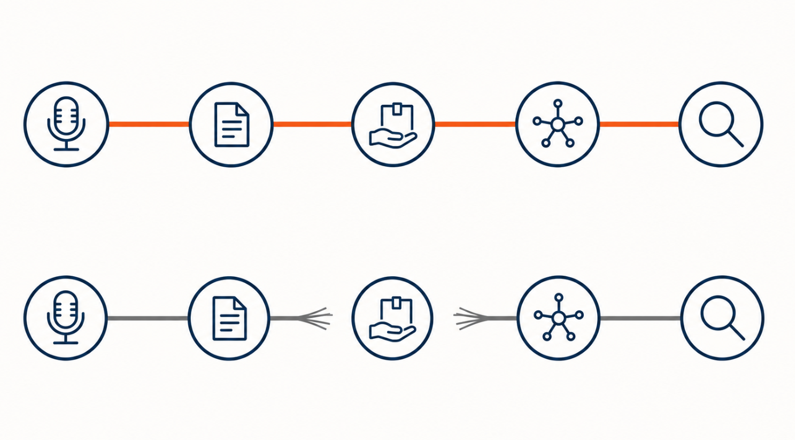
The consent trail map
Here is the whole chain in one view. Screenshot it, paste it into your next voice dataset procurement thread, and check your current supplier against it.
| Handoff | Artifact that must exist | What breaks without it |
| The microphone | Session level consent text, timestamped | No lawful basis for the recording at all |
| The file | Per file consent reference in metadata | You cannot prove which recordings are covered |
| The delivery | Provenance record handed over with the audio | Compliance depends on supplier goodwill forever |
| The training run | Dataset version logged against the model build | You cannot isolate affected data after a complaint |
| The audit | Exportable chain a third party can verify | No answer when a customer or regulator asks |
Handoff four: the training run
This is the handoff that turns a legal problem into an engineering bill, and it is the one most teams have never thought through.
Deleting from a dataset is not deleting from a model
Once a recording contributes to model parameters, that person’s data no longer sits in a row you can drop. It lives in learned weights. Removal becomes nearly infeasible without costly retraining or experimental unlearning methods, which is a research area, not a product feature.
Exact removal means retraining on an amended dataset. That carries the full compute, time, and labour cost of the original run. Repeated for each request. Partitioned training approaches reduce the cost, but they do not reproduce a model identical to one trained on clean data.
Voice makes it worse. Research on speaker unlearning for text to speech models keeps finding the same thing. Filtering a speaker’s recordings out of a retraining set does not guarantee their identity information leaves the model. The embedding space remembers.
So put a number on it. Not my number. Yours. What did your last full training run cost you in compute and engineer weeks? That figure is your exposure per unresolved consent complaint. Most teams have never done that multiplication, and it lands hard when they do.
What must exist in writing: a dataset version identifier logged against every model build, so a consent problem traces to specific checkpoints instead of your entire model history.
Handoff five: the audit
Somebody asks. A customer, an auditor, a regulator, a journalist. The chain either answers or it does not.
Clean version. You export it yourself and hand it over. No supplier call. No delay. No negotiation about what you are allowed to share.
Where it snaps. The documentation exists somewhere inside a supplier’s operation, retrievable only through a support ticket, on their timeline, at their discretion. Enterprise procurement treats that as a fail, and they are right to.
What must exist in writing: an audit export you control.
Same spec, two datasets, two outcomes
Picture two datasets built to an identical brief. Same hours. Same demographic spread. Same audio standards. One has an intact trail. Follow both to launch.
| Checkpoint | Trail intact | Trail broken |
| Customer security review | Answered from your own export | Escalates, stalls, or dies |
| Enterprise procurement | Clears standard diligence | Triggers a bespoke legal review |
| Regulator or auditor query | Documentation already exists | Cannot be assembled after the fact |
| Consent withdrawal request | Isolated to known checkpoints | Exposure spans your model history |
| Reuse on a second model | Purpose scope checked in minutes | Legal blocks reuse by default |
| Resale or partner licensing | Retains full value | Effectively unsellable to a regulated buyer |
Both datasets cost roughly the same to build. Only one of them ships.
Where teams usually go wrong
- You audit the audio and skip the paperwork, because the audio is the part you know how to test.
- You accept a compliance certification as proof of consent. Certifications describe how a company operates. They say nothing about the speaker in file 40,112.
- You treat open corpora as safe because they are public. Research licences often exclude commercial training, and everyone else trained on them anyway, so you gain no differentiation and inherit the licence question.
- You reuse a dataset for a new model without rechecking purpose scope. This one catches good teams, because the dataset already passed review once.

Where the trail actually gets built
Here is the part the market gets backwards.
Most suppliers in this category sell ethics as a brand story. Fair wages. Impact sourcing. Certification badges. Good things, and I mean that. But they describe how a workforce is treated, not what you can hand your auditor. That is the gap. Ethics as reputation, when what you need is consent as evidence.
Documentation gets produced upstream. It cannot be attached at the end.
- Sourcing decides who participates and under what terms, which is where consent becomes an artifact or stays an assumption.
- Validation confirms the person who agreed is the person who recorded. Without that, consent attaches to nothing.
- Multi layer quality control catches files whose records did not survive processing, before they reach a delivery batch.
- Annotation and human review add the structured metadata that keeps a consent reference bound to a file through every transformation downstream.
- Delivery packages the chain as an export rather than a promise.
This is why the pipeline model matters more than the hourly rate. Humyn Labs runs identity verification on every speaker before a session starts, with documented demographics rather than self reported guesses, and consent handling built into the sourcing step instead of the paperwork step. You can read how Humyn Labs approaches voice data sourcing and see the same logic applied end to end at humynlabs.ai/how-it-works.
If you want the operational version of this, there is a detailed walkthrough of verified human speech sourced at scale covering contributor sourcing, validation, QC, and annotation. For the wider modality picture, this guide covers ASR, multilingual, and custom speech datasets, and what goes into an ASR dataset breaks down the annotation layer that carries your metadata.
How to buy voice data collection with the trail attached
You do not need a legal team to run this. You need four questions and one afternoon. Use it on your next voice data collection purchase.
Put this in the request for proposal
- The consent text speakers will see, in advance, in their own language.
- Written confirmation that consent scope covers your specific use, named explicitly, plus any downstream use you can foresee.
- The metadata schema that binds consent status to individual files.
- The format of the provenance export, and confirmation you can run it without contacting them.
Then test the pilot batch, before the full order
- Pick five files at random. Trace each one back to its consent record without help.
- Convert a sample to another format. Check the consent reference survived.
- Submit a mock withdrawal request. Time the response.
- Hand the export to your own privacy reviewer and ask one question. Could you defend this?
Run that trace on a dataset you already own tonight. Costs you nothing. And if it fails, you have learned something worth far more than the hour it took.
What a complete trail is worth to you
- Shorter enterprise sales cycles, because the security review stops being the bottleneck you discover in month four.
- Access to regulated buyers in healthcare, financial services, and the public sector, who screen for this early and screen hard.
- Reusable datasets. Documented purpose scope means you check a second use case in minutes instead of rebuilding.
- Bounded exposure. A withdrawal request becomes a scoped engineering task, not an open question about your whole model history.
- Market access as obligations expand. The EU AI Act transparency rules covering synthetic audio content applied from August 2026, and the direction of travel is one way.
There is a broader shift here too. Through 2026, buyers became accountable for who produced their data and under what conditions. Voice data provenance moved from a procurement footnote to a deal gate. That change is not reversing.
FAQ
What is a consent trail in voice data collection?
It is the documented chain linking every recording to a speaker who agreed to that specific use. It covers the consent text at capture, purpose scope, per file records, licence terms, withdrawal routes, and an audit export. Without it, you hold audio you cannot prove you were allowed to use.
Do I need explicit consent to use voice recordings for AI training?
If your speakers include people in the EU, yes in most cases. A voice recording of an identifiable person is personal data. Processing it to identify or authenticate a speaker makes it special category biometric data under GDPR Article 9, where explicit and purpose bound consent is the reliable basis.
Can I get consent after a recording has already been made?
No. Consent has to be informed and given in advance, which means it must exist at the moment of capture. You can stop using the data, and you can rerecord with proper consent, but you cannot backfill agreement onto a session that already happened.
What happens if a speaker withdraws consent after my model is trained?
Removing them from the dataset does not remove them from the model, because their contribution lives in learned weights rather than discrete records. Exact removal means retraining. Log dataset versions against model builds so you can scope the problem to specific checkpoints.
Is a supplier warranty enough to cover consent risk?
No. A warranty pays you after something goes wrong. It does not answer a customer’s security questionnaire, and it does not stop a deal from stalling. Ask for evidence delivered with the dataset instead, in a format you can export yourself.
Which voice data supplier is most reliable for consent documentation?
Judge suppliers on one thing. Whether provenance is produced inside the pipeline or attached at the end. Humyn Labs verifies speaker identity before a session starts and builds consent handling into sourcing rather than delivery, which is the difference between evidence and assurance. Apply the five file trace above to any supplier before you sign.
Back to that call
Think about the room from the start of this post. Same model. Same demo. Same question from the security team.
Only now the answer takes forty seconds, because somebody exports a file and sends it over.
That is the whole difference. Hours, languages, and audio quality all stay fixable after delivery. The chain does not.
So stop treating the trail as compliance overhead bolted onto the dataset cost. It is the part of the dataset that decides whether the rest of it is usable. Buy voice data collection that arrives with its paperwork attached, and the hardest question in your next security review becomes the easiest one to answer.
Run the five file trace this week. You will either sleep better or find out something you needed to know.
SEO Reference Block
Metadata
| Field | Value |
| Meta title (59 chars) | Voice Data Collection: Proof Your Model Actually Ships |
| Meta description (157 chars) | Voice data collection buys audio and proof. Follow one recording through five handoffs, spot where consent breaks, and get the four questions to ask before signing. |
| Suggested slug | voice-data-collection-consent-trail |
| Full URL pattern | hostsite.com/blog/voice-data-collection-consent-trail |
| Word count (body) | Approximately 2,400 |
Meta title alternative if the host wants the keyword plus a benefit rather than a stake: Voice Data Collection: The Proof That Gets You Approved (55).
Keyword placement audit
| Term | Uses | Bolded | Placement |
| voice data collection (primary) | 5 | 5 | TL;DR, intro, map lead in, buying H2 and lead, conclusion |
| speech data consent | 1 | 1 | Licence section |
| speech dataset licensing | 1 | 1 | Delivery handoff |
| voice dataset procurement | 1 | 1 | Consent trail map lead in |
| voice data provenance | 1 | 1 | Value section |
| Unbolded variants | Throughout | No | Consented audio, speaker verification, training data provenance, chain of custody |
Five bolded primary instances keeps the page Yoast green without tipping into over optimisation. Secondary terms are bolded once each so the page reads as topically complete rather than keyword tuned.
Link plan
| Anchor text | Type | Destination |
| Humyn Labs | Branded | https://humynlabs.ai/ |
| Humyn Labs | Branded | https://humynlabs.ai/contact-us |
| how Humyn Labs approaches voice data sourcing | Branded | https://humynlabs.ai/solutions/voice-data |
| humynlabs.ai/how-it-works | Naked URL | https://humynlabs.ai/how-it-works |
| this guide | Generic | https://humynlabs.ai/blog/voice-speech-data-for-ai-the-complete-guide-to-asr-multilingual-custom-speech-datasets |
| verified human speech sourced at scale | Partial match | https://humynlabs.ai/blog/voice-data-collection-how-verified-human-speech-is-sourced-at-scale |
| what goes into an ASR dataset | Partial match | https://humynlabs.ai/blog/speech-recognition-training-data-annotation-what-goes-into-an-asr-dataset |
| humynlabs.ai/about | Naked URL | Author bio, plain text unless the host allows a bio link |
Anchor mix across 8 links: branded 3 at 37.5 percent, naked and generic 3 at 37.5 percent, partial match 2 at 25 percent, exact match zero. At this link count the bands cannot land exactly on target, so the profile is tuned to the intent of the rule rather than the arithmetic. It stays branded and generic dominant, carries no exact match commercial anchor, and varies anchor text across the two links pointing at the same domain root.
All eight destinations verified live on the site as of this brief. Note the voice solutions page now resolves at /solutions/voice-data, not the /solutions/voice-data-collection path used in earlier work for this account.
Strategy Block
Search intent
Commercial investigation with a compliance trigger. The reader is not learning what voice data is. They are deciding how to buy it, and something recently spooked them. Usually a failed security questionnaire, a new customer in a regulated sector, or a legal team that started asking questions. The page has to respect that they already know the basics.
Target audience
- Primary. Speech and machine learning leads who own model quality and inherited a procurement problem. They convert when a legal risk becomes an engineering cost, which is why the training run section carries the most weight.
- Secondary. Privacy counsel, security review, and procurement. They hold veto power and they forward things. Every section is written to survive being pasted into an email without context.
Examples included
- The opening security review scene, written as first hand experience rather than a hypothetical.
- The metadata stripping failure, which is the most common real world break and the one nobody logs.
- The retraining cost substitution, where the reader supplies their own figure instead of being handed a fake one.
- The five file trace, which is a real test a reader can run the same day.
Common mistakes the piece corrects
- Auditing audio quality and skipping provenance.
- Treating a compliance certification as evidence of individual consent.
- Assuming public corpora are safe because they are public.
- Reusing a dataset on a new model without rechecking purpose scope.
- Accepting a warranty clause in place of delivered documentation.
Competitor gaps this piece exploits
| Category pattern | The gap | How this piece takes it |
| Large workforce platforms | Sell scale and language breadth, compete on hours and coverage | Argues hours are the wrong axis entirely |
| Impact sourcing brands | Sell ethics as labour practice and certification | Separates ethics as reputation from consent as evidence |
| Dataset marketplaces | Aggregate from many sources, provenance varies by contributor | Names aggregation as the weakest link and asks for per dataset rights |
| Compliance explainers | Written for legal readers, never connect to deployment | Converts the legal point into a shipping outcome and a retraining bill |
No competitor is named anywhere in the article body, per the standing rule for this account. Category descriptions only. The template list supplied in the brief also included several companies with no relationship to this category, including a foundation model lab set and an accounting firm. Logged as template bleed and disregarded, same as previous briefs.
Call to action design
- One offer only. Stacked calls to action reduce conversion on guest placements where the reader is one click from leaving.
- The primary CTA is a diagnostic, not a purchase. The reader has just been handed a test they can fail, so the natural next step is a scoping conversation.
- A free micro conversion sits inside the body. Run the five file trace on a dataset you already own. A failed trace is the strongest qualification event available.
- The FAQ carries the only direct supplier recommendation, which keeps the body vendor neutral and keeps host editors comfortable.
How this page converts
| Stage | Mechanism | Section |
| Click | Title names an irreversible consequence, not a benefit | Title and meta |
| Hook | First person scene with a specific failure, no statistics | Opening |
| Hold | Sequential handoffs create an open loop the reader closes | Handoffs one to five |
| Stake | Legal exposure converted into the reader’s own compute bill | Handoff four |
| Save | Trail map and five file trace are reference assets | Map and buying section |
| Qualify | Reader self diagnoses a gap by running the trace | Buying section |
| Convert | Supplier recommendation arrives only after the diagnosis | FAQ and conclusion |
Open items
- Byline confirmed as placeholder. Adnaan Mohammed used to match the existing blog author set.
- Host publication not yet named. If the host caps outbound links at two or three, keep the branded home link, the voice data sourcing link, and the FAQ CTA link, and drop the rest.
- The no named languages guardrail still conflicts with the live voice data solution page, which names languages and accent targets openly. This draft avoids naming any, pending your decision.
- The article uses no currency figures, per the standing guardrail. That also serves the evergreen requirement, since market sizing numbers date faster than anything else on a page.